
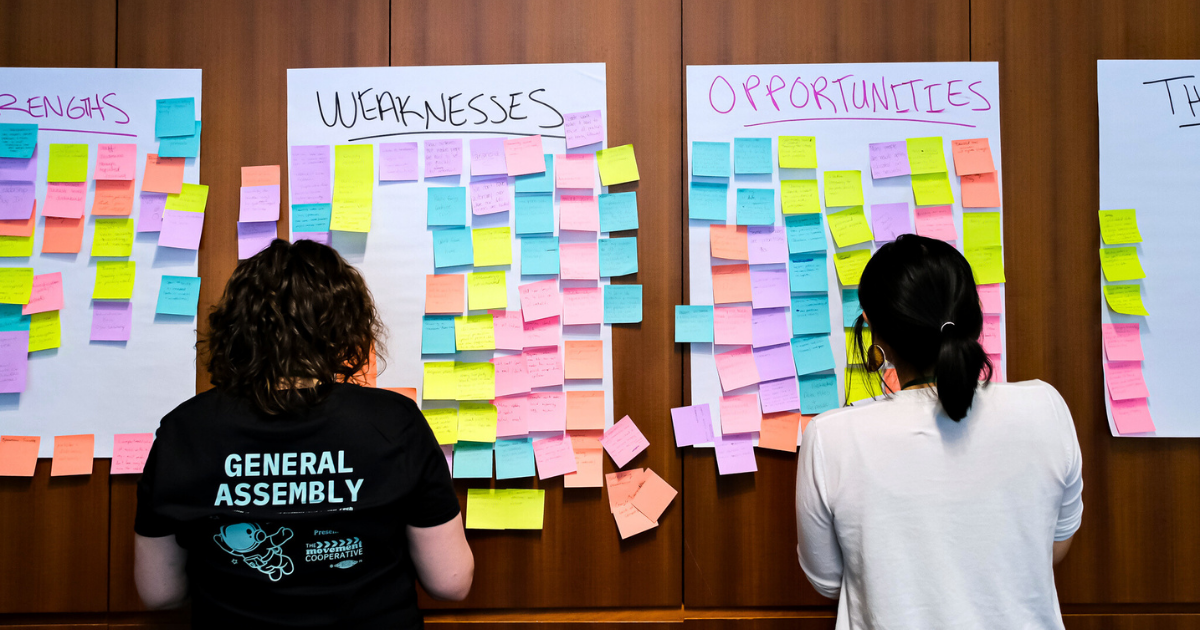
Infrastructure isn’t a broad, meaningless term. It’s what makes movement work possible. Think of every text, phone call, door knock, voter registration drive, protest event, and tabling effort you’ve ever been a part of. No matter how you organize, it is all reliant on data and technology—not as an afterthought, but as the fundamental basis for how we do, well, everything! At TMC, we believe that lasting power is built on a strong foundation of systems, tools, and care shaped by and for organizers.
TMC’s Theory of Change model guides how we achieve our mission to democratize access to data and technology and empower TMC member organizations to do their best work. It also explains why we believe the steps we’re taking to achieve our mission will work.
TMC Members Are Experts
Whether they specialize in winning elections and protecting voting rights, in climate resilience policy and legislative process, or in bringing the wisdom of lived experience from decades of organizing their communities, TMC members know their stuff.
We trust in and value their expertise, and want to ensure they have all the tools possible at their disposal to make the most significant strides they can. Whether that means registering more voters more efficiently, creating a unified picture of their membership base to design more impactful campaigns, or creating advanced data visualizations to map communities where they work and identify neighborhoods that require special outreach.
TMC members have a decisive collective impact on how the left wins, and the volume of their work is immense. Since our inception in 2018, our members have held over 699 thousand events, made one billion voter contact attempts, organized in 31 million canvasses, made 239 million calls, and sent 1.6 billion texts.
Reimagining the Backbone of Movement Work
Across the progressive space, movements are often slowed down by disconnected tools, inaccessible data, and systems that don’t reflect how organizers operate. TMC was created to help fix that.
As a member-led cooperative, we support almost 90 national and state-based member organizations and over 1,400 affiliates. Our members aren’t just users of our services—they co-create the offerings that help strengthen the work we all care about. We work across disciplines—data, engineering, organizing, and research—to create support systems that reflect the way movements actually operate and evolve.
We believe infrastructure should be adaptable. Whether members are scaling up for a national campaign or building hyperlocal coalitions, we offer customizable support rooted in shared strategy rather than one-size-fits-all partial solutions. That adaptability is key to how we serve such a broad and diverse ecosystem.
A Framework for Shared Power
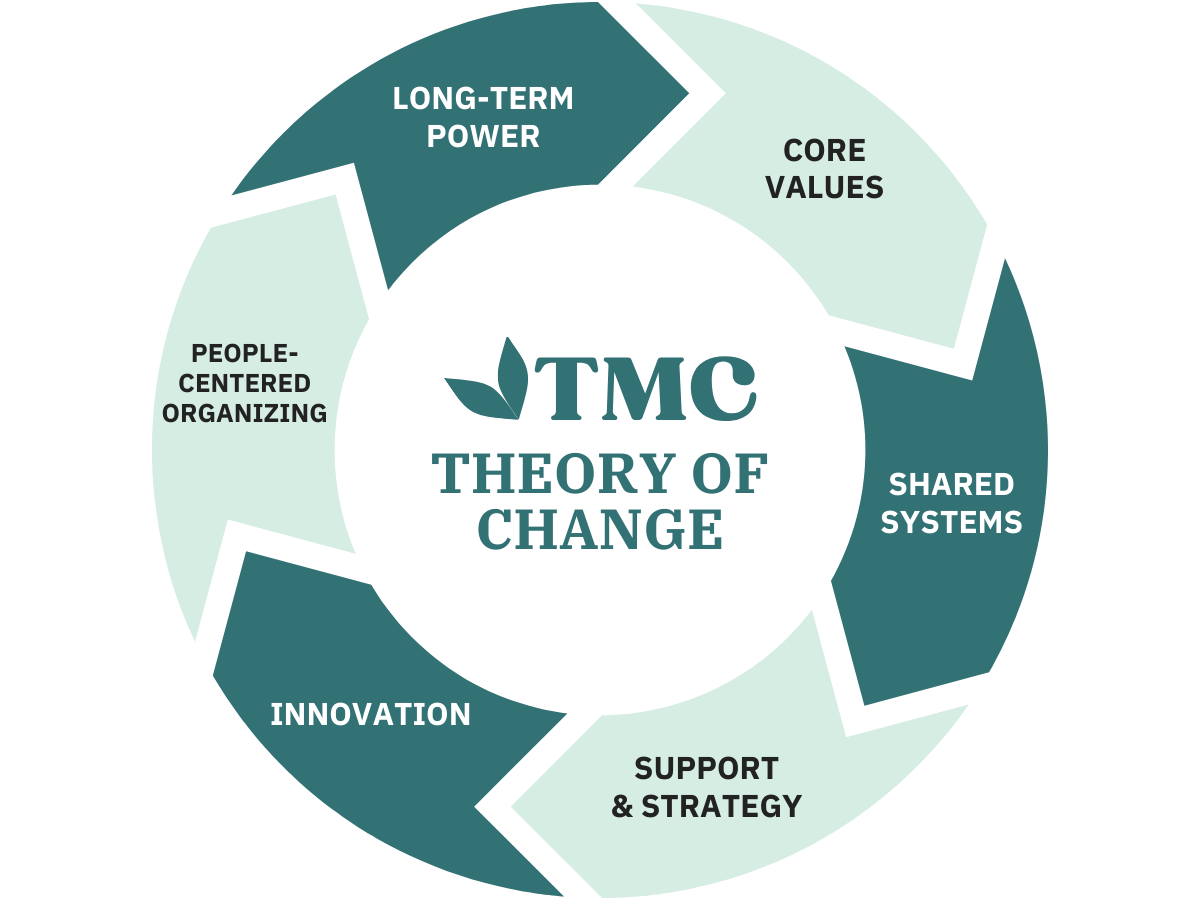
TMC’s Theory of Change is a cyclical model rooted in six interconnected pillars. Together, these phases guide how we build and evolve shared infrastructure for the movement:
Core values: Our work begins with trust, connection, and community.
Shared systems: We offer reliable, scalable infrastructure, data tools, and access to technology negotiated on behalf of members. We invest in advanced security protocols to help protect all our members from digital threats.
Support & strategy: We provide engineering, research, trainings, and collaborative learning spaces that meet members where they are.
Innovation: We create shared space to test ideas, spark creativity, and build on what works.
People-centered organizing: Our infrastructure supports the most impactful tactics based on our members’ goals—whether smart digital strategy for winning elections or relational, community-first tactics for membership growth and resistance actions.
Long-term power: Together, we fuel strategies that help win elections and also extend beyond electoral cycles and lead to sustainable, collective change.
Each phase feeds the next. The result: infrastructure that’s values-aligned, adaptable, and rooted in the real needs of the people doing the work. Taken together, they offer a blueprint for building a sustainable, values-rooted cooperative infrastructure designed to support a movement-wide return to governing power at the federal and state levels.
Why This Work Matters Now
Movements today face real challenges: burnout, disinformation, and underinvestment in organizing tech. The moment calls for durable systems built with care and intention, not one-size-fits-all faux-solutions. Our Theory of Change offers a roadmap for co-creating infrastructure that helps movements grow, adapt, and win together.
This approach also ensures we’re not just responding to short-term demands, but building for the long haul. Our framework helps members stay rooted in what matters most—people, strategy, and values—while also making space for innovation and long-term planning.
As one of our partners, Million Voters Project, shared:
“The tools and training gained through TMC have been transformational in our work activating the rising majority in our communities. There are entire programs that would not happen without the supercharging effect the TMC infrastructure has had on our alliance.”
Now, “infrastructure” can be a little obscure—and honestly, it can mean different things to different members at TMC.
For some, it means our data warehouse, a repository of all the information they have about their supporters, and the dashboards and interactive charts everyone at their organization can use to get a quick, easy picture of their organizing progress.
For others, it’s the vast connective network we’ve built between the tools they’re using to email, text, and manage volunteers, creating a smooth, seamless volunteer experience from sign-up to the first, second, and third canvassing shifts.
And for others, it’s something even bigger—not just the warehouse, the data syncs, and the tools, but the entire community of TMC. The community not only enables the work; we actively build and maintain a network of support and education that makes the work better.
Our infrastructure is also people: peers to bounce ideas off of, an analyst at another member organization who offers to help fix some wonky code, the TMC staffer who responds to a late-night support ticket on election night. It’s a rare kind of infrastructure that provides gentle reminders in community spaces that we’re not alone in the fight for a better world.
That possibility of a better world won’t be achieved by accident, but it’s also not as far off as it can seem. TMC membership means organizations don’t have to build or troubleshoot complex systems alone. It means having a real voice in shaping the tools and systems that power the work. When infrastructure reflects how organizers actually operate, teams can move faster, experiment more boldly, and focus their energy on strategy and impact.
If you’re interested in learning more about how this framework shows up across our work, we invite you to keep following us here (set up an RSS feed!), on LinkedIn, and on Bluesky for more updates. We’ll be sharing a wide range of content, from our Engineering team’s insights to uplifting the voices of members and partners who are helping build what’s next for the movement.
Could your organization benefit from more interconnected systems and advanced data integrations? Explore TMC membership here. Together, we’re laying the groundwork for a stronger, more connected progressive future.
