
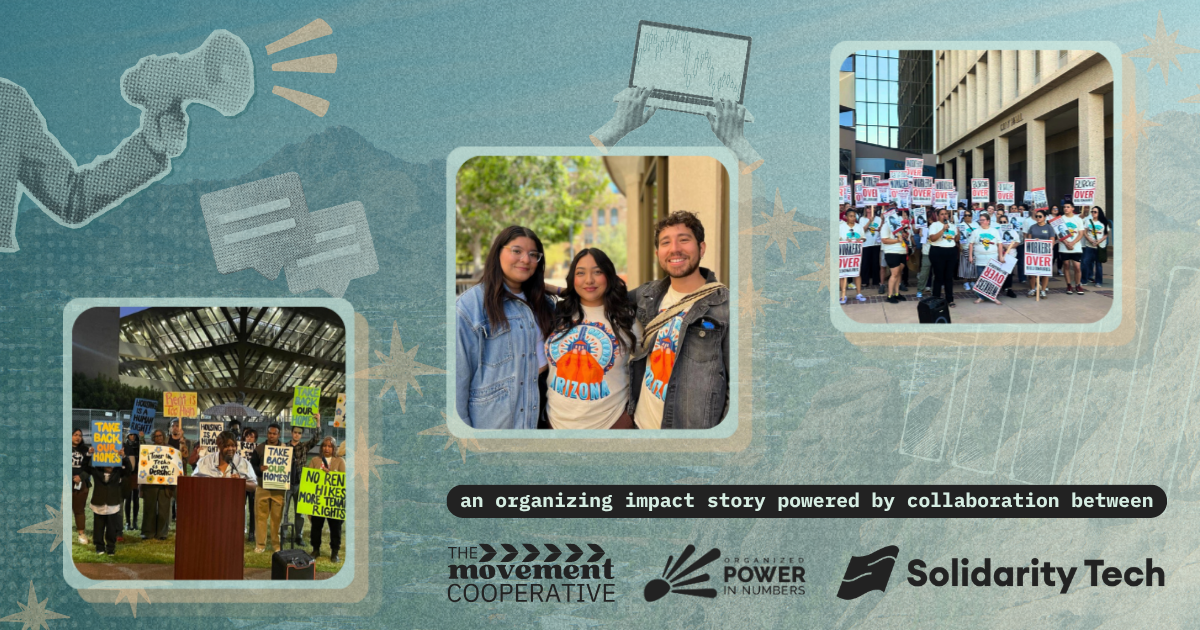
Banner features organizers and community members from Organized Power in Numbers’ Take Back Our Homes Campaign in Arizona. Photos courtesy of Organized Power in Numbers.
TMC was originally organized around a simple belief: movement organizations deserve access to cutting-edge technology.
That belief helped inspire the launch of our Next-Gen Customer Relationship Management (CRM) search in 2025. After hearing from members about challenges with some of the foundational tools they rely on to stay connected with their communities, we knew it was time to explore new options.
A year into our Next-Gen CRM journey, members are onboarding to new systems, like Solidarity Tech. Organized Power in Numbers (OPIN) is one of our members who has joined us on the Next-Gen CRM journey while working at the intersection of worker power and digital, data-driven organizing across the Sunbelt. We recently caught up with them to learn more about how Solidarity Tech and the Next-Gen CRM pilot process are already helping expand their reach, strengthen regional programs, and build momentum for long-term change in the communities they serve.
We connected with Kim Selig, OPIN’s Tech Director, to talk about what the OPIN team learned over the past cycle, how they experimented with new organizing tactics, and the real-world results of their work in the last year.
TMC: What were some of OPIN’s key challenges within the movement tech ecosystem?
Kim: So much of organizing is built from incredibly messy tables of data, a sea of Google Sheets, or even handwritten notebooks and wall charts. That’s how most organizers learn to do this work. But it’s unsustainable and, frankly, inefficient at achieving the impact the progressive movement must make in time-sensitive, high-pressure moments.
At OPIN, we’ve been really focused on re-establishing some of the long-standing messy systems that we may have had to DIY at our start. Collecting and sorting data from so many different places–events, petitions, conversations with community members, the list goes on–is always going to be complicated. But we recognized that if we wanted to maximize our impact, we needed a data system that wasn’t. It needed to be user-friendly, able to connect to the other tools we use to run programs, and built for organizers like us who work in communities long-term to create change.
TMC: Trying new team systems can be quite the challenge, between research, evaluation, onboarding, and adoption. What were your hopes or concerns going into your search, and how did it work out?
Kim: I think the reason tech for the movement has been an ongoing challenge is that a lot of our foundational technology is optimized for short-term electoral campaign work. For organizations dedicated to working with communities over multiple years, those who mobilize communities to build social momentum and sustain progressive wins over time, our technology must be able to adapt to our needs as well.
Through the CRM pilot program and search for new voter contact platforms, TMC really facilitated a space where we could investigate traditional organizing practices and pull out what worked, identify the gaps in our tech stack, and dig into the available solutions. We’re confident now that we’ve added some key resources that will fill those critical gaps.
TMC: Are there any real-world wins OPIN has helped facilitate thanks to TMC membership and access to strong technology?
Kim: After doing that intentional reflection and reimagining of our core technology, we had to put it to the test. Since last summer, we’ve leaned into these new resources during our campaign work in Phoenix, Arizona.
Our team leads ongoing phone banking, text banking, and canvassing efforts in Phoenix, tracking details of one-on-one conversations using Solidarity Tech. With everything in one place, our team was able to update, organize, and integrate multiple sources of information without hassle. That means the work on the ground became easier to do and led to better engagement.
This recently supported a huge win for Phoenix residents. Through our conversations, we heard repeated concerns around affordability, rising cost of childcare, and the need for emergency assistance.
We learned the city council was planning public hearings to determine the ’26-’27 fiscal budget and recognized we were having conversations about exactly what residents needed the city to invest in. So our organizing shifted into empowering the community to have a voice in the city budget hearings and recruiting residents to attend and engage at those public hearings over several months.
Finally, in May, the city council approved a historic community-focused budget for Phoenix.1 It included multiple wins for the communities we work with:
- A historic $5 million investment into childcare affordability
- A $1.65 million increase in flexible assistance to help with rent, food assistance, and emergency funds, for a final budget line of $3.15 million
- Almost $1 million dollars to increase youth programming
- Increased the homelessness responsiveness program to $18 million to offset decreased federal funding
- $6.6 million for expanding affordable housing production
Because of our improved organizing efforts with a new tool stack and the benefit of shared cooperative data, Phoenix residents will see a 200%+ increase in city spending for public community service programs in fiscal year 2026-27, at a time when rising cost of living, stagnant wages, and slashes to federal funding have meant more and more of our communities are relying on these programs to survive.
TMC: After such a big success, what are your hopes for the future of your work?
Kim: Our primary focus is ensuring our regional network affiliates are reaping the benefits of the tech gaps we’ve filled.
At Organized Power in Numbers, we believe the people closest to the problem are also closest to the solution. So one of the advantages of being a tier one member at TMC is that our 20+ affiliates across the country also get access to the new tools we’re using.
While some affiliates have been using Solidarity Tech for months, we’re still working diligently to onboard our entire network this year. After seeing the power of our tech in Phoenix, we recognize there’s an opportunity to tie the rapid-response efforts we’re leading across the country, like the work being done in the Sunbelt to defend immigrant workers, into long-term power building for more communities.
That means we want our state and local affiliate leaders to get access to the tool, train their staff to use it, and strategize how they can leverage the technology in their communities.
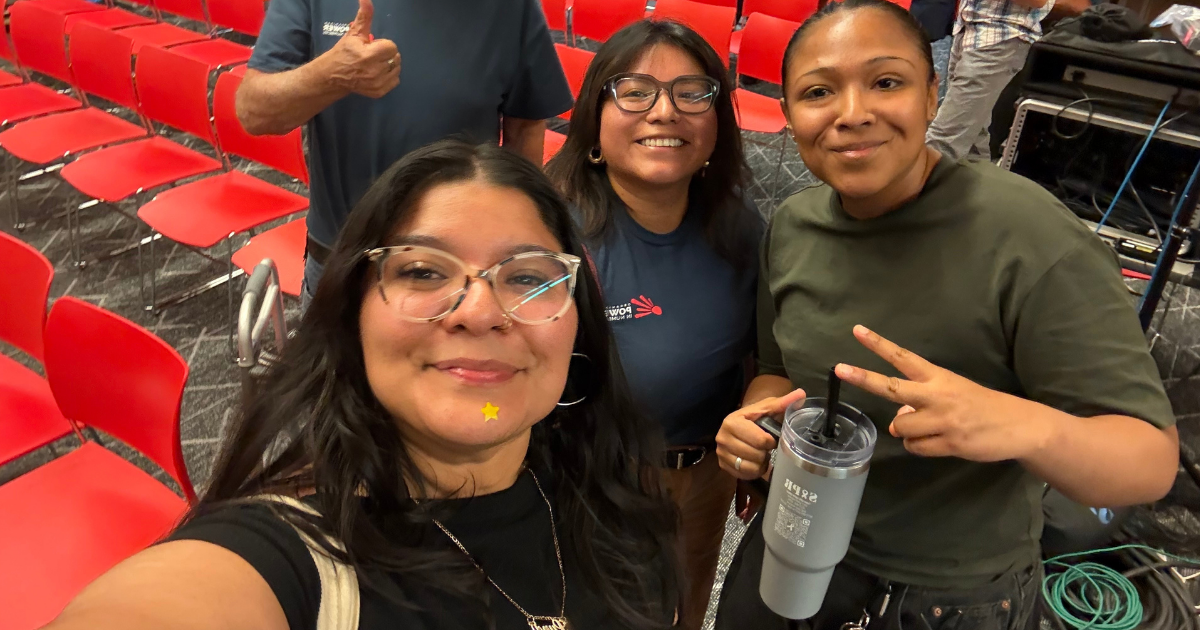
Organized Power in Number staff and volunteers pose for a selfie after attending a Phoenix City Council meeting.
OPIN’s story about what they achieved in Phoenix reminds us what’s possible when movement organizations have the support and resources they need. Every organizer fighting for childcare funding, housing access, or immigrant protections deserves technology that lifts up their work instead of holding it back.
It goes back to one of the beliefs TMC was built on: as movement systems and infrastructure get stronger, so does our collective ability to create change. That’s the promise our cooperative exists to fulfill: when one organization finds a solution, tries something new, or asks a question, every member benefits, and every community we touch gets closer to the change they’re organizing for.
Want to dig deeper? Learn more about our Next-Gen CRM RFP process, explore TMC membership, or find out how you can support TMC’s work.
